Before the frame I take my gloves off. I flex my fingers through the sterile air. My leg is singing to me, my thigh flaring, my calf damp with blood. I limp forward and lift the strap from my shoulder and lower the duffle to the floor, wincing at the noise it makes as it meets the hardwood. I am alone, the building empty, but still I wince. I look down at the duffel; the wire cutters, the masking tape, the hammer, peering back at me out from an unzipped eye. I pause and double over, pressing hard against my thigh with my elbow. The wound makes a sound like a boot in mud and I have to physically bite my tongue. I think I can still feel a shard of window lodged in there, burning like a molten rod. The room drifts around my head as I rise to shake back my sleeve and glimpse my watch. I wince again as the burner vibrates against my thigh. I draw it from my pocket between two fingers, wipe the blood from the screen with a sleeve, and read the message.
Aldo: aux power off – sec system dead. u have 5.
I look to the far wall lined with attendant windows, gored with pillars of moonlight that cast the gallery in a lonely blue. Outside, the creeping of tyres and the purring of an engine crawl through the silence of the old market square. Brakes squeak, and the engine drifts to sleep.
From the duffle I retrieve a thick and spotless jute cloth and stretch it between both hands, letting it drape over my forearms. My breaths are ragged.
Tomorrow, the logistics team commissioned by Christie’s Paris will arrive at the museum and begin the painstaking process of unmounting the work from the wall, preparing the shipping crate, ordering and arranging the paperwork and identification numbers and barcodes and porterage timetables. When the painting makes its journey to Paris, it will do so within an unmarked and unremarkable box, at night, by road, and under armed guard. That was the plan, at least. Tomorrow, the logistics team commissioned by Christie’s Paris will arrive to find only an empty stretch of wall.
There was once an adage in this business that the merchandise was most vulnerable in transit, that a roadside confiscation was easier to pull off than stealing a postcard from the gift shop, that only a fool would risk the trouble of breaking and entering when they could just wait on some side road in the Belgian countryside for a van to pass. These days, the opposite is true. The climate has changed. The world has moved on. The roads are packed and the museums are empty.
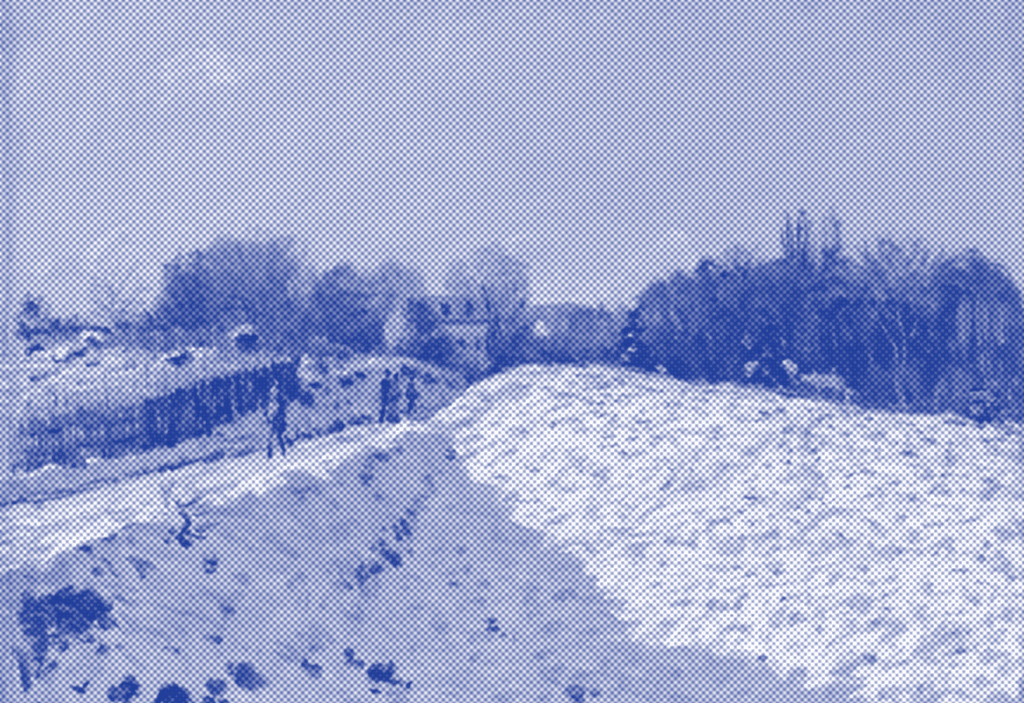
I hobble toward the frame and inspect it, deciding whether to lift from the bottom or to seize it from both sides. It isn’t large, and it shouldn’t be heavy. I reach the jute cloth forward and squint at the painting. Some landscape. Some landscape that our buyer wants for over three million euros. Some landscape that’s already brought me far more trouble than I signed on for. I glare at the painting, my hands, covered by the jute cloth, hovering beneath the frame, hovering beneath three million euros. For a moment, I feel I’ve forgotten why I’m here. I am looking, truly looking, at the painting for the first time. Snow covers the ground, but the sky is clear.
Before me stretches a field in winter, blunt strokes of blue and white rolling over each other toward a small country house squatting in the background. Everything is drawn towards the centre by the house’s quiet gravity; a narrow path stamped to one edge, trailing between, on one side, a fence of stakes that rise from piles of snow like an arrangement of sharpened pencils which enclose a plot of snow-capped heaps – piles of wood, or chicken coops – and on the other side a shallow ditch, a wedge, shadowed by a lowering yet unseen sun to the pale colour of a frozen stream or the sky above, trailing away and sharply brightening as the ditch rises again to form a mound that first brings the eye toward, but then obscures, the end of the path that leads toward the squat country house, then climbing and rolling to the side before a dense bar of naked trees composed of muddy streaks and warm blurs. The trees, the country house, the fence of stakes, together form an earthen strip that splits the snow-covered field below from the sky above, pale and broken only by a handful of small clouds that lack the strength to keep themselves whole, shifting into the translucent grey sheen that seems to be daubed over the heavens otherwise the chalky blue of a polar sky. The world is open. So much of it is snow, so much of it is sky.
On the path ahead of me, three figures drift away into the valley formed between the low heaps of earth that rise on either side, smears of dark soil emerging from under the snow at both their base and top. A woman walks, draped in a shawl and with an almost funerary bonnet on her head to fight the biting cold, arms interlinked at the folded elbow with her escort, a man whose coat tails descend to the tops of his thighs, the pair of them just a few paces behind a young man who strides with his hands tucked under his armpits. In the opposite direction, having already passed the couple arm in arm, comes a man with a knit cap upon his head, wrapping his moleskin chore jacket about him and cutting down the path with sharp strides, knees bent as if he were marching uphill.
“Bonjour,” he tones, nodding as he passes.
“Bonjour.”
The packed snow squeaks under my boots as I continue down the Rue de Voisins and were it not for the songbirds that flutter from treetop to treetop a hollow silence would pervade, with no breeze to disturb the air and all other sound drifting limply into the snow.
The hunched young fellow and the woman in her shawl and the gentleman upon her arm disappear from view as they round the edge of Auberge de Saint‑Martin, the squat guest house by which the path leads, the at once damp and drafty inn of Monsieur and Madame d’Ogier that seems to attract, as a bitten plum upon a windowsill in summer does flies, all manner of unsavoury characters with more money than manners.
To the west the sun is dipping, bathing in a faint pinkness the plot rung with sharpened stakes in which piles of firewood lie stacked under the snow. My breath leaves me in a thick veil.
Like conspirators around a fireplace the trees loom in around the Rue de Voisins as it corners past the yard and stables of the Auberge de Saint‑Martin through and onward to Louveciennes and for a few brief moments it feels as if I am walking into the mouth of a forest as the blue sky seals up and thin strands of light wave in dappled patches through the branches of the trees. I pause at the gate before the yard of the Auberge. The board and batten shutters are fixed wide open against the walls clad in cracked flaxen paint. From the rear door of the inn Monsieur d’Ogier emerges with a pail that sways in his grip as if impelled by its own spirit and he tips the swill or food or waste or whatever it is steaming into the snow. He pulls the cap from his head and wipes it against his creased brow and as he stands his eyes look over his high and rounded cheekbones and into mine.
“Salut, Jacques. Rather brisk day for a walk, no?”
“Bonjour Monsieur d’Ogier.” I fold my arms over the gate. “Brisk is putting it lightly. Can’t say I’ve ever known a winter like it.”
“You’ve not seen winter, boy. The year of the long lack, that was a winter. 1846. Snow fell upon Paris for four days and four nights without a moment’s pause. By the time the sky were blue again, the Seine had frozen as far as from Rouen to Troyes, and we’d fit skates to our boots and run along the ice from here and into Saint-Denis.”
I’m thinking I’ll tell Monsieur d’Ogier I don’t believe a word of it when the rear door swings open with a crack and a man comes stumbling out, each foot fighting for the honour of being the next to stamp the snow and his arms rolling about him like those of a windmill, and his sudden appearance breaks d’Ogier from contemplating his souvenir past and he seems to recall he holds an empty pail in his hand and that he came out here to do something and as this realisation settles upon him he first returns his cap atop his bald head, briefly doffs it in my direction, then seizes the staggering patron by the lapels and drags him back inside, presumably to continue drowning the fellow in a cask of wine. The door slams behind him.
I heave my satchel from one shoulder to the other and carry onward along the Rue de Voisins out from the shadowed glade of the trees and over the brow of a hill upon which a view presents itself of the rooftops of Louveciennes, heavy under the snow. The church spires break into the crisp sky, and the trees that line the boulevards are skinny and naked. I leave the path as it curves down toward the village and follow the route alongside the aqueduct. The cobbles of the wide road cannot be seen under the packed snow, lined with the passage of cartwheels and stamped with the going of boots. Besides an open carriage, pulled by a single steed and seating a single rider, rumbling far ahead of me upon creaking wheels, the road is empty and I am alone with the sound of the birds. Windows of light between shadow blink upon me as I pass beside beside the sturdy arches of the aqueduct, the sun beyond continuing to drift toward the horizon like a falling feather.
Soon I leave the Allee des Arches and am passing a dormant and barren vineyard before a brief walk along another wide street, this one warded on either side by pleasant houses that sit with some distance between them, surrounded each by low walls of plastered-clad bricks or fences of sanded stakes or borders of leafless shrubbery. At the street’s end I come to a house that is rung by neither wall nor fence nor shrubbery yet which maintains all the same a superfluous gate of painted green wood halfway up the path that leads to the front door.
Before the house stands a presence I had not expected and have never before seen. A fiacre carriage waits to the side of the road, the driver sat, crop in his hands, ready to depart, the two horses whickering. The carriage’s door is open, and beside stands the presence, a man slim yet solid as an iron candlestick, his collar upturned and a dark cravat about his neck, a cape hung over his shoulders open to reveal a waistcoat of the same fabric as his trousers. He draws upon a pipe and looks at me without a word.
“Bonjour Messieurs,” I say as I pass, turning up the path toward the house.
The driver turns, but neither he nor the man smoking the pipe reply.
Most days I have the habit of hopping over the redundant gate or skirting around it, but today, sensing stern eyes on the back of my neck, I open it up and walk straight through. Its hinges hum shut behind me. I hear one of the horses stamp.
I rap upon the door and it opens almost immediately. For a moment, Madame Abelard looks clear over the top of my head, scowling in the distance. The sour expression on her face softens, then hardens again when she looks down to find me.
“You,” she says. “Come.” She ushers me into the hallway and closes the door. A heavy smell of leeks and garlic sits in the air. “His is a strange understanding of no guests nor visitors,” she mutters. “He’s in his quarters.”
“Merci Madame Abelard.” I bob my head in her direction and climb the stairs. The corridor is lined with doors on either side, and at its far end sits a window that looks out upon a small garden. I walk to the furthest door and press my ear against it. No sound comes from within. I tap upon the wood with one knuckle. Some shuffling arises, and then the door opens.
The artist blinks at me, squints, scratches his beard, then rubs his forehead.
“Jacques,” he says. “I’d forgotten you were coming.” For a moment it seems he might forget to invite me in as well. He appears as if he’s just arisen from a dream, yet the creases on his linen shirt and the vibrant stains upon his waistcoat make it look as if he’s been awake, and wearing the same clothes, for days. He shakes his head vigorously. “Please,” he says, stepping aside and opening the door wide.
The room is small but airy, with a single large window, wide open, presenting a view of rolling fields, all covered under the endless snow. An iron frame bed, unmade, is tucked into the corner of the room, and against each wall, canvases lean in various states of completion. One of them, only one, has been fitted within a frame. A stack of sketchbooks sit beside the bed. There’s no desk in the room, and the only chair is occupied by a pile of folded linens. Before the window stands an empty easel.
“What can I do for you, Jacques?”
I pull my satchel round to my front, unbuckle the clasp and lift out one of the brown glass bottles from within. “Your turpentine,” I say, presenting it to the artist. “Fetched from the station.”
He looks at the bottle for a while and then closes his eyes. With both hands he rubs his brow and beard at once and it looks as if he’s attempting to unscrew his head from his shoulders. He groans, and lowers himself on to the corner of the bed.
“Of course,” he says. “Of course. Place it over there,” he gestures to a paint-stained wooden box with brass carry handles. The box lies open, revealing the brushes and tubes of pigment within. A palette sits within the inside of the lid, coated in blotches of all colours and shades. It looks to me like a sky in summer in a distant land. “I’m sorry for your trouble, Jacques. I’d forgotten about the turpentine. In truth I no longer need it.”
I place the bottle by the case and spin to look at him. He raises his hands.
“Worry not, worry not, I’ll still reward you for your trouble. Though I’m afraid I can’t give you as much as promised.” He plunges his hand in his waistcoat pocket and summons me over. I lay out my hand and he drops three coins into my palm. I count them, seven centimes in total. “Help yourself to some food too. Madame Abelard’s a good cook but I’ve no stomach for supper.” He gestures to a side table by the door. A porcelain bowl sits atop, still half full with a pale stew of leeks, carrots, and what looks to be beef. A heel of bread sits to the side, partially submerged. I pull out the spoon and leave it on the side table, take the bowl in hand, and sit upon the floor to drink.
“You’ve enough turpentine already?” I ask, wiping my mouth with the sleeve of my coat. I pick out the heel of bread and plunge it into the soup until it’s utterly sodden.
“I’ve none beside what you brought.” The artist is looking out the window as he speaks to me. “I don’t need it.”
I draw what’s left of the bread from the stew and chew upon it.
“Madame Abelard has found a new tenant for the room. I’ll be leaving at the end of the month, and I’ll be selling all this before I leave.”
“You’ve found buyers for the paintings?”
He sighs. “An industrialist from Paris came today to take a look at my works. He’s spending a week in Louveciennes for some clean air.”
I recall the mirthless eyes of the candlestick man outside and pull my coat tighter around me as a draft cuts through the room.
“And he’ll buy them?”
“No. He’d no interest in what I showed him, but he offered to take my equipment off my hands. He gave me a good price. Apparently he’s intrigued by the idea of taking up a new pastime. He’ll return tomorrow to collect the items he’s interested in. Hopefully I’ll convince him to take this turpentine too.”
I set the bowl down on the floorboards. “How will you paint without your equipment?”
“I don’t intend to.” He rises from the bed and walks toward the window, hands clasped behind his back.
“How will you sell paintings if you don’t make paintings?”
“I don’t need to sell paintings. I’ve found work as a farmhand in Moret-sur-Loing. Besides, take my word Jacques, I will sell no less paintings than I am now.”
“If you don’t need to sell them, why stop painting them?”
“For no one wants them, Jacques. I couldn’t convince the man outside to part with even fifty francs for a landscape I had exhibited at the Salon.”
I stand and set the bowl back on the side table. “But you said you don’t need to sell them.”
“Selling them is not the point, Jacques. No one even wants to look at them. The public not buying the paintings is merely evidence of the fact they are unliked.”
“But you like them.”
“Hardly.”
“I like them.”
The artist turns from the window and looks at me. His face is drawn and his eyes are veiled in shadow. “That’s kind of you to say, Jacques.” He lifts the easel from where it stands and begins to fold up its legs.
“If other people saw them, I’m sure they’d like them too.”
“Perhaps. I hope they would. But other people aren’t seeing them, Jacques. No collector will buy from me and no exhibition will consider me. It’s been over five years since the Salon accepted anything of mine. What use is all this if no one sees it?”
“You see it,” I tell him. “I see it.”
“Is that what it’s for,” he mutters, something drawing his gaze back to the window, “all this time and effort for but one person to enjoy your work?”
“Maybe.”
He seems startled by my answer, as if surprised I had heard his question.
“Maybe,” he repeats. “Maybe that’s what it’s for.” He places the collapsed easel by the wooden case of paint and brushes. “But if so, I’ve no longer the energy for it. What is the use in the labour if no one sees the fruits? What effect can my work have, if I cannot share it?”
The artist shakes his head as if dispelling a bad memory.
“What about that one?” I point to the framed painting that has been waiting in the corner.
“What about it?”
“You’ve already had it framed.”
“Yes. A gentleman from Lyon had expressed his interest, so I had the framer mount it in preparation.” He looks down at the painting as if it were a stubborn patch of dust one has noticed only after putting away the broom. “But the buyer withdrew his offer at the last moment.”
The artist steps over to the painting and picks it up, inspecting it at arm’s length. His gaze is distant.
“Perhaps you could try to sell it to the gentleman from Paris when he returns tomorrow?”
“Perhaps.” The artist sighs and his arms lower.
“May I see it?”
“Of course, Jacques.”
I lift the strap of my satchel from my shoulder and lower it to the floor. The remaining bottles of turpentine within give a dull ring as they knock together. I cross the room. The artist holds the painting out to me. It isn’t large, and it doesn’t look heavy. Before the frame I take my gloves off. I flex my fingers through the sterile air. A beam of pale light pierces the open window and lands upon my arms. Outside, the creaking of a carriage and whickering of horses break through the silence of the fields. Wheels squeak, and the carriage drifts away. For a moment, I feel I’ve forgotten why I’m here. I am looking, truly looking, at the painting for the first time. Snow covers the ground, but the sky is clear.
 Telling Time
Leave a comment