
This essay was originally published on Medium on April 16th 2024.
What do I like most about history?
Thanks for asking. That’s a tough one. There’s something fascinating about reaching back in time to a culture that feels so unimaginably remote, so different from our own, only to find that the people living at the time were not so different from you and I; they made jokes, they had dreams, they laughed, they cried, etc. etc. Or on the other hand, it’s also intriguing to find people in the past doing things so fundamentally different to how we do them now that its impossible to imagine exactly what possessed them to act the way they did.
Aside from that, the problem solving, the fluidity, and the space for argument all serve to place history firmly among my favourite interests. When I was young, I thought history was the process of learning about the past. “Things happened before you were born, read about them, remember them.” It actually wasn’t until relatively recently that I discovered just how little we historians know about the past, and that actually what we have is this huge shifting image, or rather interpretation, of the past that changes every time some new fragment of the past is discovered, or every time a new historian casts a critical eye over the fragments we have, and contributes their best guess to our growing image. We can strive for objectivity, and really we should, but we can never truly get there. Even a first hand account of a period as recent as yesterday can’t ever be objective — there will always be the influence of emotion, context, experience, interpretation clouding the lens. And that, to me, is half the fun.
What do I like least about history?
It’s definitely the racists LARPing as Anglo-Saxons on Instagram, hammering their primary school grasp of history into a shape that supports their misguided political beliefs.
Before I start I want to make my stance on a few things clear;
- The more people interested and engaged in history the better. It would be amazing if more people wanted to learn about history, and I appreciate social media is a great tool to facilitate that.
- Historical re-enactments and LARPing are great. Not my thing, personally, but great. Honestly I’m not brave enough to dress up in armour and run around with a sword but sure, some days I wish I was. If that’s what you’re into, more power to you.
- Anglo-Saxon history is (in my opinion) fascinating. I think it’s cool. I obviously don’t think there’s anything inherently racist about being a historian of the Anglo-Saxons. Second now to maybe medieval Welsh,the Anglo-Saxons are the historical culture I’ve spent the most time researching.
- I’m also not here to bash people who know less about history. There’s nothing wrong with having a limited grasp of history (or no grasp at all), but if you’re using an incredibly insufficient comprehension of history to substantiate basically any point you want — that sucks.
All Hyperlinks Lead to Rome
If there’s a period of history that seems to crop up the most in online spaces, it’s ancient Rome. If social media is to be believed, the average man is thinking about the Roman Empire around twice a day. There’s been a clear increase lately in general interest in ancient Rome, and stoicism has also gained a semi-mainstream status. For whatever reason, Rome is having a renaissance, again — and that isn’t an probelm, by itself. I’m personally excited by the idea of more people engaged in history. However, there’s two sides to every denarius. I wasn’t (and you probably aren’t) a stranger to the people (and by extension, social media accounts) that use, or hide behind, ancient Roman iconography to support some pretty reprehensible views. I think we’ve all seen at least a handful of twitter accounts toting ancient Roman marble bust profile pictures spouting some of the most useless, misguided dogshit imaginable, and using a flimsy understanding of ancient Rome to justify it.
Amidst all this, there also seems to be this strange internet subculture that have attached this odd, mythic longing to the ancient Romans, and treat the society as if returning to 27 BCE would somehow solve all their problems.
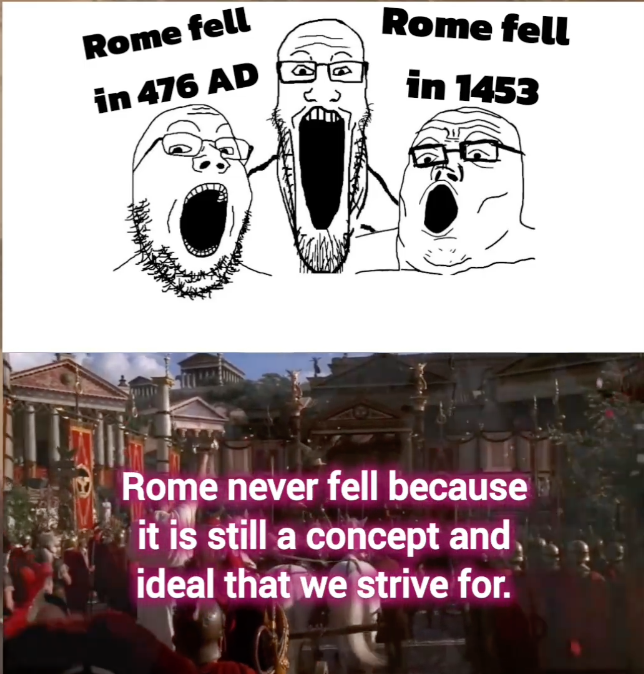
Here’s a post I found whilst researching this article which I think exemplifies this peculiar fetishisation of Rome. I don’t really think this image is offensive, but I do think it’s pretty stupid. What on earth is the argument here? What’s the “ideal” you’re striving for? The best thing about this meme is the actual historians engaged in debate up top, pictured as wailing soyjaks, and underneath them, a still from the TV show Rome used to demonstrate just how great the ancient civilisation apparently was. I’m not here to debate the merits of arguably one of the most powerful empires in antiquity, but it really is beyond me exactly what the person who posted this thinks they’re striving for. There’s any number of things this person could be clamouring after, but my suspicion is it’s not a return of chariot racing (which would be pretty cool), and probably more to do with the return of what they perceive to be as an ancient culture that held values reflecting theirs.
A lot of people have already discussed this, so I won’t go into to much detail on the “Racists ❤ Ancient Rome” thing here, but it seems, in summary, that a lot of people view ancient Rome as an example of a culture that was “strong”, “white”, and “western”. If we look at the evidence however, it’s pretty clear that Rome was only sometimes strong, not nearly as white as some people like to argue, and western in a geographical sense, sure.
It’s not my intention to knock down a strawman here, but I don’t want to focus too much on Rome in this essay. If you’re interested, Aeon has an interesting article on the white supremacist obsession with Rome, and Vox has a compelling interview on the topic, although I don’t necessarily agree with all the arguments made in both publications. I do quite like the appeal at the end of the Vox article, encouraging the politically progressive to “not to accept what they’ve [been] told about what history is or must be.” The areas of history becoming swamped by misinterpretation, misrepresentation and false characterisation are the areas that need critical, balanced, and impartial eyes the most in order to be saved from what looks like it might be the fate of ancient Rome: eternity serving as set dressing for racists. The best history is done when historians explore the past without a desire to find a particular thing to confirm a particular fact — this is something that people across the political spectrum are guilty of, but it is obviously a particularly dangerous practice when utilised by white supremacists.
The weaponisation of history is nothing novel. It has always been, unfortunately, almost inseparable from history itself. As long as the study of the past has existed, so too have people that will dig up the past and invoke chosen aspects to support their own aims, ideals, or views. Even today we are still shaking off the spectre of Victorian historiography, which informed a great deal about how we consider the past. Racist adoption of classical antiquity, as briefly discussed above, is nothing new; the same technique was relied upon by Nazi Germany.
The Anglosfear
Today I want to understand why the waters are so murky around the Anglo-Saxons. Spoiler: I think it’s going to be for basically the same reasons.
There’s been some online debate over the past few years about the name “Anglo-Saxon” and whether it’s really serving a purpose in modern historiography. I’m yet to encounter a reason that has convinced me to stop using the name to talk about the historical group; It’s a useful and clear shorthand for a certain (arguably maybe a bit diffuse) culture at a certain time. Absolutely, It wasn’t a name widely used in contemporary sources, and it wasn’t the name the Anglo-Saxons used to refer to themselves, but I think it’s a helpful name for historians. That said, the arguments made by progressive academics insisting we interrogate the effect the term has on the study of the period are compelling, and the assertion that the name “Anglo-Saxon” has been used by certain groups to support certain racist beliefs is undeniably true. Unfortunately, this discussion has devolved, in some areas, in to more kindling for the culture war, with people rather disingenuously arguing about whether actually using the name Anglo-Saxon makes you a racist or not, and I find a lot of these arguments I’ve come across to be in pretty bad faith. I’ve also actually not seen anyone say “if you use the term Anglo-Saxon, you are a racist” but a lot of right-wing “sceptic”, “critical”, “free-thinker” articles and internet comments seem to be arguing that left-wing academics are indeed making this case. I’d welcome any evidence to the contrary on this one.
One thing I didn’t realise when I started researching this piece was that “Anglo-Saxon” is being used completely differently in the United States. In the UK, I had never heard anyone use it to describe anyone other than a person who lived in England in the early medieval period. Yet it turns out some people in the States are using it in a way that is so obviously racist that it’s not even a dog whistle any more, its just a regular, incredibly loud, whistle. It’s pretty clear to me what US politicians mean when they talk about “Anglo-Saxon political traditions”. I have a feeling they don’t want to go back to summoning thegns to a witenagemot to advise the king. So whilst I do think the term Anglo-Saxons is useful if we’re talking about the group of Angles, Saxons, and Jutes that settled in Britain around the start of the early medieval period, It’s an absolutely useless word to talk about white people today. If the argument being made is to stop using Anglo-Saxon to talk about white people in the present day, then consider me on board.
People have always looked to the past for a sense of cultural stability. This is particularly true of groups who have faced oppression, colonisation, or the erosion of their own culture for other reasons. They look back in time, for evidence of the culture that has been lost, and they resurrect it in the modern time. A lot of time, these resurrections become warped; they aren’t quite the same as their historical counterparts, or perhaps they’re based on shaky historical precedent to begin with — but in my opinion, that doesn’t really matter. Cultural practices change and evolve in countless ways, that’s normal. Clinging to or strengthening a cultural identity, is among other things, a threat-response.
As it happens, there’s a lot of people who believe English (or Anglo) culture is under threat, and I imagine that’s why some of them are latching on to the Anglo-Saxons for a sense of identity. The thing is, these people have misinterpreted an increasing diversity within England, and a few discussions on whether we should keep up statues of slave-owners and mass murderers, as signs portending the extinction of English culture. But no one is taking away any English culture. You’re welcome to have a cup of tea. You’re free to go morris dancing. No one’s stopping you from eating fish and chips. You can read Shakespeare, you can read the Brontës. You can listen to Greensleeves, you can listen to Led Zeppelin. You can play cricket (although I can’t imagine why you’d want to go and do that last one). The language, culture, and practices of the English are not under threat, as much as these people might want to convince you they are. And yet in the rare cases where English heritage is actually at risk — take for example the plans to dig a motorway underneath Stonehenge — I’m not seeing any protest from the “defend English culture” crowd. It’s my guess that the reason I’m witnessing a glut of people on the internet calling themselves ‘Anglo-Saxon’ and posting fan-cams of Alfred the Great is because they perceive their own culture to be under threat. Suffice to say, it isn’t.
The Pipeline
The following paragraphs include the discussion and dissection of racist images and racist language, parts of which I imagine some readers may find challenging to look at.
The people I am talking about are not those with a general, scholarly interest in the past, nor those who enthusiastically engage in their own research on the history, nor are they those who possess no more than an aesthetic fascination with certain periods — my issue lies with those who are romanticising a past they don’t understand and are using this obsession with the Anglo-Saxons to urge a return to some kind of ethnically homogenous land they feel has been “stolen” from them. It’s a particularly dangerous practice, as I personally fear that young, impressionable people may be drawn to these online spheres by a general interest in history, and once there, they’re suddenly being exposed to racist propaganda. Take the screenshot below, for example, taken from an “Anglo-Saxon history” Instagram account.
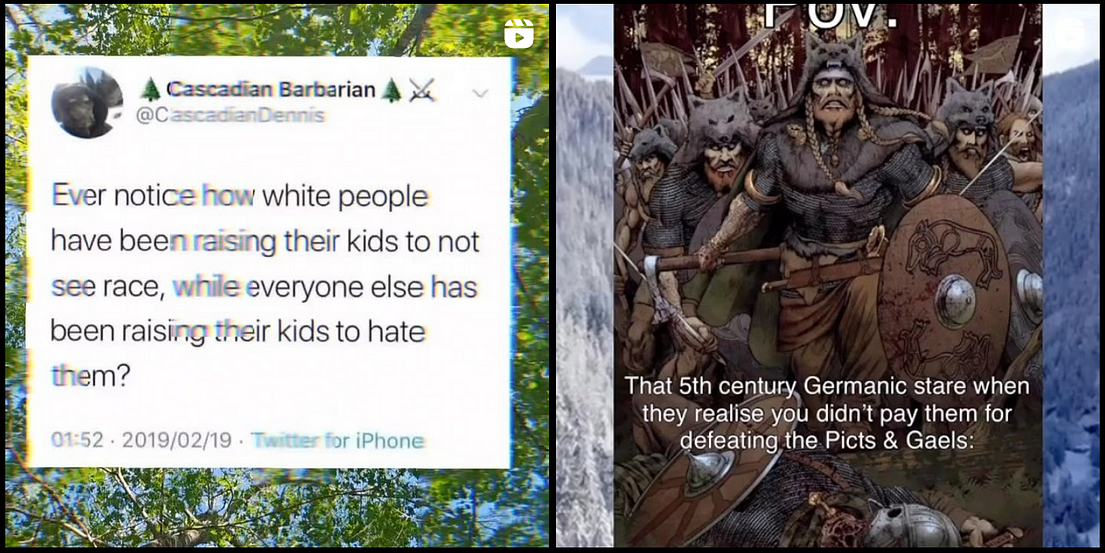
They posted the image on the right first. Perhaps a mildly humorous history meme. It’s not making me laugh, but that’s not the point. I can see why someone might find it funny or interesting, and follow the account. Then, they get followed up with the 1–2 punch of incontrovertible racist drivel: the second post, on the left, spreading the dogshit “great replacement” lie. It is worrying to think how many impressionable people, young people, or those with limited critical thinking skills, might be roped into these online communities through general historical interest, and then be bombarded with incredibly harmful, racist nonsense.
These people are latching on to genuine, common fears, and presenting an easily digestible reason to explain them all away. “Have you noticed the world sucks? It’s because there’s less white people.” Yes, the culture of the world is changing. And yes, the direction we are going in is worrying. We need to have a serious think about the values we hold as a society — on this, it seems almost everyone on earth can agree. What I cannot contend with is the idea that any ‘cultural decline’ is a symptom of a world in which we are becoming more caring, more open-minded, more fair. I absolutely do not think that a move towards equality is a bad thing and I never will. The ills of this world have not been caused by the fight for equal rights, freedom of movement, or freedom of expression.
I have a feeling that the modern ‘Anglo-Saxons’, on the other hand, disagree with me. I presume they look at the state of the world, and feel that much of what’s wrong with it can be lain at the doorstep of progressive thinking. Thus they turn back to the past to find some culture that they perceive as “whiter”, “straighter”, and “more Christian” than the one they find themselves in now. If you want to connect with the culture you believe your ancestors descend from, great. If you want to form a stronger connection to your faith through researching the religions you think your ancestors followed, fine by me. But the warping of history to support your own equally warped political beliefs and world view isn’t just bad history, it’s utterly morally corrupt.
It’s my hope that by going through some of the warped representations of Anglo-Saxon history I’ve found lingering in some of the less pleasant corners of social media, and taking a critical look at them, I can separate the fact from the racist fiction. I also hope this might, in some tiny way, repair the reputation of Anglo-Saxon history. It’s a fascinating period of study, and it would be much healthier if it was pruned of the bigots, and entered into by a new generation of open-minded historians and enthusiasts.
One of the first, and worst, examples I came across was a video featuring a statue of Alfred the Great with the words “natives first” plastered across his face, whilst a rapid slide show of historical illustrations flicker behind him, all set to the tune of Grimes’ Genesis. If you’d told me in 2012 that racists would be using Grimes as the soundtrack for their Instagram propaganda, I’d have laughed in your face, but these days I’m well beyond being surprised by any news that involves Grimes. And actually, judging by Grimes’ twitter activity, she might be the perfect musician to provide the score for this garbage.
What on earth is going on here? I suppose the most logical line of criticism is to wonder why they’ve paired Alfred the Great with the statement “natives first.” Firstly, I don’t feel I have to explain why the slogan itself is xenophobic, harmful, and bereft of logic — that’s fairly clear. From a historical perspective it’s also quite confused. The creator/poster of the image is clearly a big fan of what they call “Anglo aesthetics”, so I can understand why they’ve chosen Alfred the Great as their poster boy. There’s no arguing that Alfred was a remarkable figure and he’s certainly worthy of study. Worthy of veneration, though? That’s a different debate. However, what’s obvious to anyone who’s taken a moment to think about him critically, is that he’s a useless figure to pair with the promulgation of a “natives first” ideology. Alfred’s distant lineage is hard to trace effectively (he may have had some Briton in him) but what’s important is that he was an Anglo-Saxon king — and the Anglo-Saxons were not natives of the land they later held dominion over. It’s a blatantly racist post to make in the first place, but using Alfred to push the point just seems nonsensical.
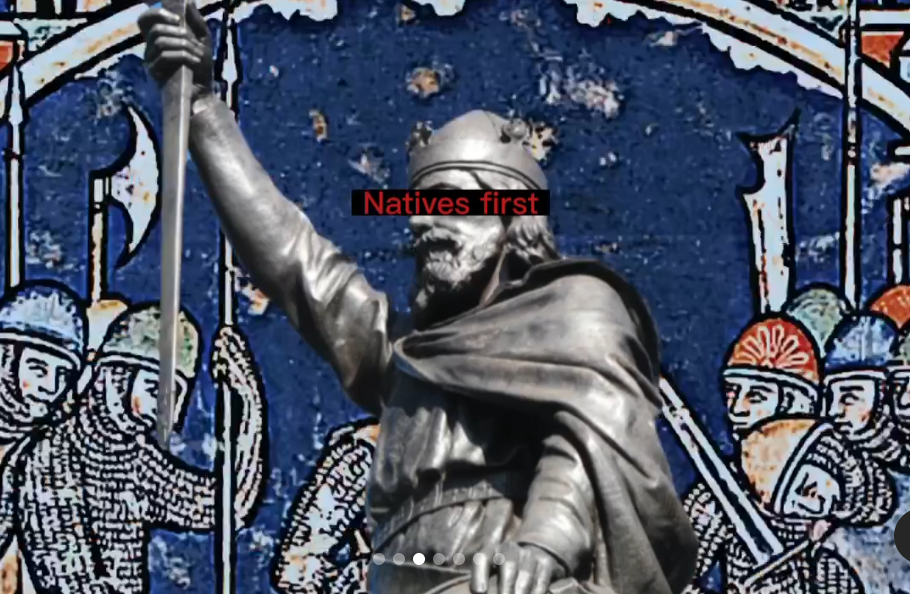
What I’ve come to realise whilst researching this subculture, this internet community, is that they aren’t really united by a love for Anglo-Saxon history, or history at all, but by their shared belief that the Anglo-Saxons were an early example of their white, western progenitors. It becomes fairly obvious when you notice they’ve all got something along the lines of “Anglo” “Germanic” “Saxon” “Pan-Germanic” in their usernames. They aren’t using the term Anglo-Saxon like the historians do, they’re using them like the US politicians. They’re using it because it serves their purposes better than just saying “white.”
Here’s another great example of how these people beat history out of shape to support their own opinions, only this time, to bolster their own religious beliefs.
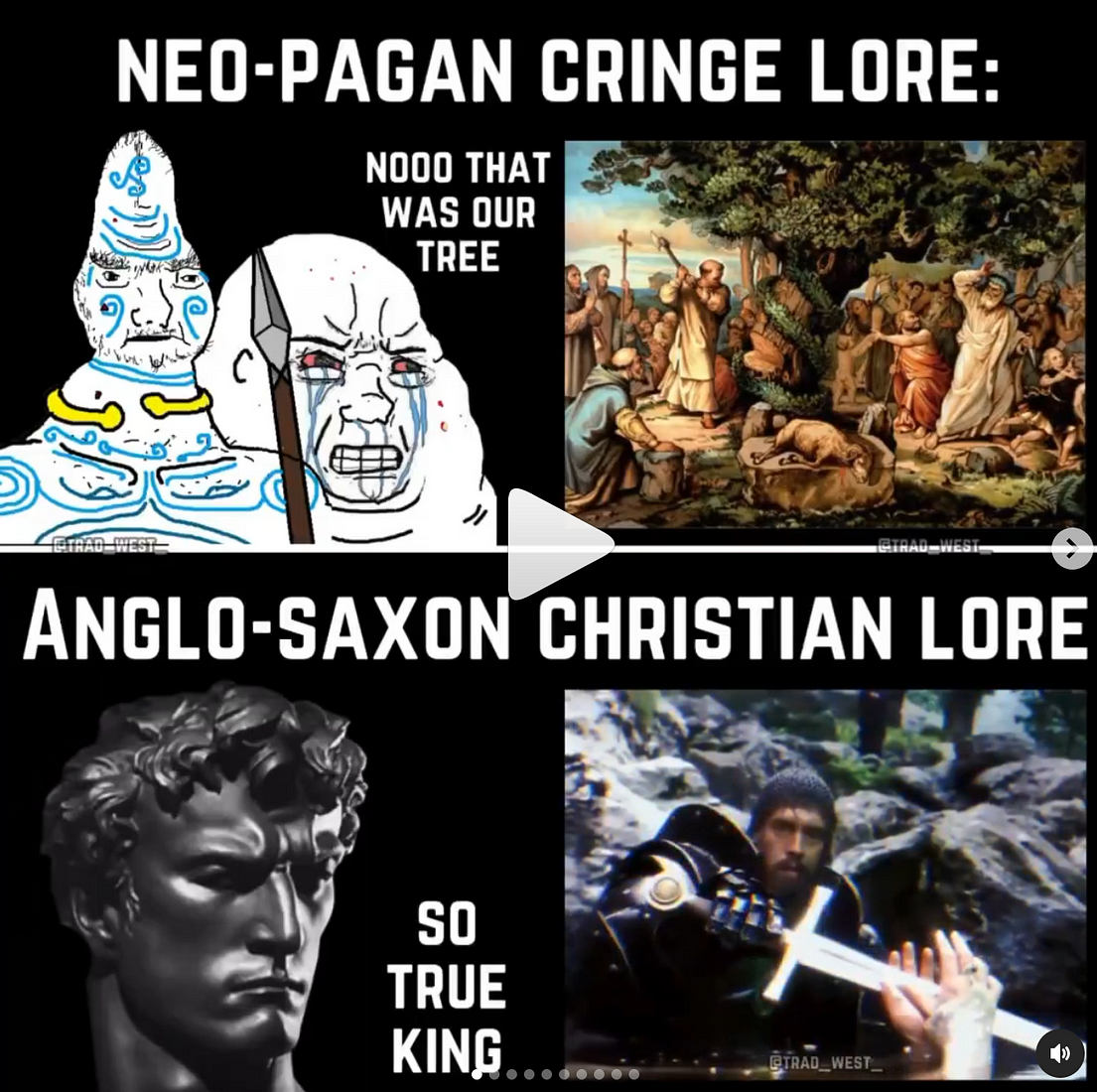
Up top we have the pagans. Judging by the woad body paint, they’re supposed to be Celts, most likely native Britons. They’re supposed to be stupid because they’re revering a tree — which is of course silly, and not at all like ascribing sacred significance to a wafer (both are fine, by the way). At the bottom, as the example of the chad “Anglo-Saxon Christian lore” we have…
King Arthur.
A fictional character based on a shred of tentative historical evidence, but more importantly, a man who was… Welsh. Not English. Not Anglo-Saxon. Not Germanic. Welsh.
The example they’ve chosen for Anglo-Saxon Christian culture is… a myth perpetuated by the native Britons. In fact, he’s a man who the Britons claimed fought against the Anglo-Saxons and defeated them. The Historia Brittonum, a semi-mythical history of Britain written around 800 CE tells us:
Duodecimum fuit bellum in monte Badonis, in quo corruerunt in uno die nongenti sexaginta viri de uno impetu Arthur; et nemo prostravit eos nisi ipse solus.
Roughly: “On the twelfth was the battle on Mount Badon, in which Arthur slayed nine hundred and sixty of them [the Saxons] in a single charge on a single day, and no one slayed them but Arthur himself.”
The early sources also include Arthur roaming around Britain alongside pagan gods, and it wasn’t till later that the church started ascribing Christian values of chivalry to him. But what do I know? I suppose there’s nothing in the Bible that says you shouldn’t be hanging around with witches and wizards and people who claim to be able to foretell the future. Is there?
A related, and maybe more bizarre example from the same account, included a new slide show of “English culture”. It begins by featuring what look like manuscript illuminations, some illustrations of mythical events (King Arthur receiving Excalibur, for example), images from Britain’s more recent past, and then… pictures from Lord of the Rings? I suppose you could argue “Tolkien’s work is an example of English culture”, but then… show a picture of Tolkien? I’m not kidding when I tell you this video included a picture of British troops at what looked like Rorke’s Drift, immediately followed by a picture of a bloke riding on an eagle.
Something else that this online coterie of confused racists seem to really struggle to get their heads around is the story of Hengist and Horsa. Hengist and Horsa were allegedly Germanic brothers who lived around 400 CE, and were invited to Britain by a ruler named Guorthigirn (also known as Vortigern), whereupon they turned on Guorthigirn and led the Jutes, the Angles, and the Saxons in their invasion of Britain. This myth gained a lot of popularity in the 18th century, but it’s mostly understood by historians these days to be exactly that; a myth. Hengist and Horsa likely didn’t exist (at least, not in the way the story suggests), the evidence for Guorthigirn is similarly shaky, and it’s quite clear that the Anglo-Saxon settlement in Britain was a slow process over many years, not a sudden, single invasion. Hengist and Horsa do appear in the Historia ecclesiastica gentis Anglorum, a history written by the English monk Bede around 730 CE, but this doesn’t prove much about their existence; only that their story persisted. If a future historian dug up a Spiderman comic in three hundred years, that would not be conclusive proof of the existence of Peter Parker. Bede lived around two hundred years after the purported arrival of Hengist and Horsa and was certainly basing his writings off oral tradition. Prominent Germanic historian Rudolf Simek has argued quite convincingly that Hengist and Horsa originated out of Germanic pagan myth. In my personal opinion, it’s possible that Hengist, Horsa and Guorthigirn might have been historical figures, but any truth of their lives was warped into mythology many many years ago, having been twisted into a fallacy even before Bede’s time. If there’s any doubt that what Bede presents is more of a folkloric origin myth than it is real history, he insists that Hengist and Horsa were the great great grandchildren of the Norse god Odin. Seems fairly unlikely to me. And not very ‘Anglo-Saxon Christian lore’ of them.
So this example below isn’t offensive in itself — it’s just misinformed. However, it can certainly be used to spread a harmful idea, and the account posting it is doing just that. They’re using it to argue some kind of inherent Germanic superiority.

It was at this point in my research that all the pieces clicked together for me. This isn’t anything new; it’s the same old white-pride racism that’s been swimming around for decades. Dressing up this racism in an interest for Anglo-Saxon history isn’t anything new either — all that’s changed is that now it’s being done on Instagram.
Whatever reason these people are giving for an interest in Anglo-Saxons is a pretence, I realised. They like the Anglo-Saxons because they’re Germanic. They’re “aryan”, they’re “white”.
My suspicion was confirmed very soon after. It didn’t take much digging through the posts about Hengist and Horsa until I came across a fan-cam of Oswald Mosley throwing up Nazi salutes, set to the tune of Interworld’s Metamorphosis. It says so much about your historical literacy to go to bat for a man that was essentially universally reviled by nearly every social class in Britain, and it says far more about your depth of thought when you make a TikTok fan-cam for him like he was some kind of intensely racist K-Pop idol.
Part of me thinks, and a larger part of me hopes, that it’s children making these posts, because the thought that anyone who’s reached adulthood could be producing things not only so misinformed, misguided and offensive, but also so embarrassingly cringe, seems hard to swallow. The fact most of these videos are being set to songs made viral via TikTok does suggest that it’s children crafting them. On the other hand, maybe this is all just “ironic” rage bait, and in which case, I’m the real idiot, because I’ve fallen for it and spent a week writing this article. Yet something tells me you don’t sit down and make a slide show of your favourite fascist unless you’re really into it.
I’ll finish by briefly mentioning the strangest video I came across whilst researching. A final, mind-bogglingly cringe video entitled “Germanic Classics” which featured (to the tune of Basshunter’s All I Ever Wanted, for some reason) shots of:
– The TV show ‘Vikings’
– King George V
– People waving plastic British flags
– Swedish people dancing
– Patrick Bateman smoking a cigar
– Anti-feminist, Covid-denying Dutch TV personality Eva Vlaardingerbroek
– Lots of Queen Elizabeth
– Several angles of Neuschwanstein Castle
– Jeremy Fragrance
– Basshunter himself
– James Bond
– An actual map of the Third Reich
You can’t look at this list and tell me this video was made by anyone other than someone yet to leave middle school. I tend to avoid the trap of labelling all those who disagree with me politically as Nazis, but any doubts I had that the people behind these accounts were actual, out-right, full-blown, card-carrying Nazis was dispelled by the time the video finished.
Racists warping history is nothing new. But has it ever been so depressingly cringe?
Final Thoughts
At the end of the day, does it matter if it is or isn’t just children behind these screens, toying with history they can’t grasp and latching on to ideologies they don’t fully understand, ready to drop it all as soon as they realise how misguided and embarrassing it all is? The response should be the same.
I’m not exactly sure what can be done, but I think those interested in the past have something of a duty to cast a critical light on history when its being used as a weapon to promote fascism. And for all of us, it remains vital to challenge these views when we encounter in real life. If there’s anything that I hope is clear, it’s that the opinions of these fascists are, as they always have been, deeply corrupt, and woefully foolish — it doesn’t matter if it’s dressed up in an interest in history, it doesn’t matter that it’s on a flashy Instagram video set to catchy music, it’s all just hateful, harmful garbage. If you’re someone who isn’t interested in history: don’t fall for this rubbish. And if you’re someone who is into history: always do your own research, read around a subject, find a period that intrigues you and do your own digging. And don’t let these people claim history for their own. It isn’t enough to mock them, nor to simply correct them. Let’s keep history from the clutches of the bigots. It feels in parts that Rome is already lost, the Pepe the Frog of history. When I see someone touting a marble statue display picture, my first thought is certainly not “there’s a normal person with a healthy interest in history”. Anglo-Saxon history faces a similar fate. If we abandon Anglo-Saxon history and leave it to languish as a cesspit inhabited only by the far-right, then we are not only allowing these people to besmirch decades of meaningful, balanced historical research, but we also allow them to push away those with a genuine interest in history who feel that the discipline is not an inclusive one. If we want to continue to invite new minds into the fascinating world of Anglo-Saxon history, I think it behooves us to not abandon the word, but to defend it, to rid it of the false narratives, the myths and misrepresentations, and leave no space for extremists to wield it as a weapon. Ultimately, if we can succeed in dispelling the myths that surround the Anglo-Saxons, and introduce the public to the captivating findings of meticulous research, there will be no part of Anglo-Saxon history left upon which the racists and the extremists may grip.
Further Reading
The below article from Professor Howard Williams quite nicely summarises my thoughts on the term ‘Anglo-Saxon’. It is well worth reading for more information on the ethnohistorical usage of the term by extremists, whilst contrasting this with the utility the word still provides to historians and archaeologists.
Why we should keep the term ‘Anglo-Saxon’ in archaeology | Aeon Essays


 Telling Time
Leave a comment